Why You Shouldn't Trust Just Anyone
Everyone has RV advice. The question is… Is that advice actually correct?
"Send it!"
"It'll be fine!"
"I'm towing a XX trailer that weighs Y,YYY and I don't even notice it's back there. It pulls great! You'll be fine!"
Have you run across statements like these when you're researching your truck and trailer combination to determine if it checks out alright?
These are just a small dose of daily occurrences I run into on various RV and towing forums. There are so many anecdotes from people towing an unsafe combination and then propagating that same philosophy to anyone that will listen... just because "they're fine." Oh, certainly this means that you’ll be fine too!
However…
They didn't ask how much you or the family or any of the stuff in the tow vehicle weighs.
They didn't ask about other numbers such as max hitch ratings on your tow vehicle.
They didn't ask how much or what you’re planning on loading into the RV.
They didn't ask where you'll be towing it or what style of camping you planned on doing.
They just simply ignored all factors and gave their own anecdote based on what they "think" — not the solid facts behind your specific situation.
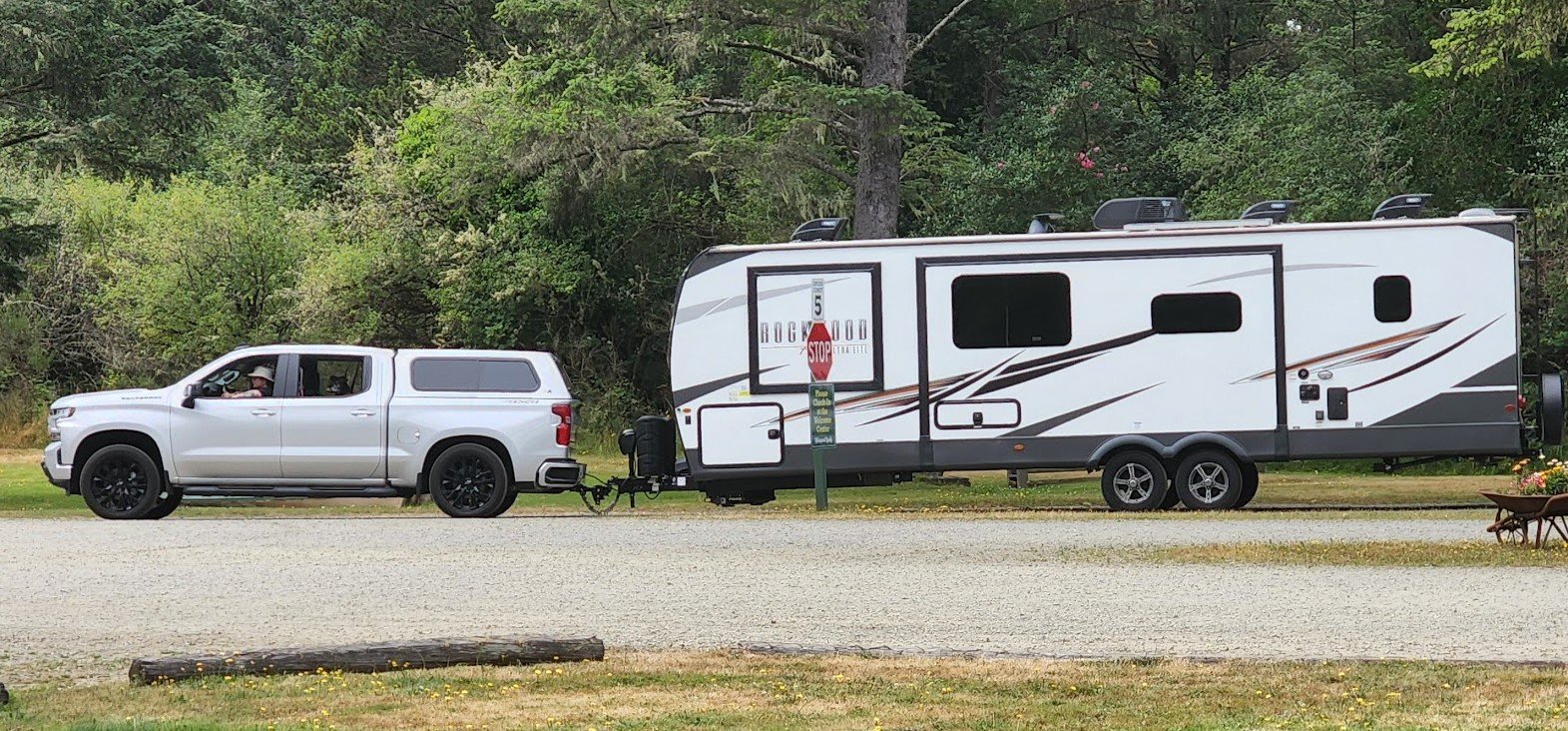
ABOVE: Another overloaded rig checking into a campground. Not only are they over on their truck’s payload, but they are over on max hitch weight by having their WDH spring bars disconnected (even if they were connected, they’d still probably be over). Anyone else noticing that their chains are dragging?
What really is concerning to me in these off-the-cuff responses of "Send it!" and "It'll be fine!" is that the responder probably did absolutely no math or research. Instead, they just glanced at your picture you posted and then injected their own (possibly) erroneous truck/RV pairing mistake right into your situation.
The people actually asking these safety and towing questions about their new or future RVs are truly and genuinely concerned — and that's why they had the guts to post the question publicly. They have this underlying feeling that they are (or will be) on the edge and they just need that last bit of reassurance — that maybe someone else, or many someone-else’s — will agree with them so they can lay their worries to rest.
However, if you've reached this stage, it is probably not fine.
It's pretty easy for us to look at a setup and think "Dang, that's big. I wonder if this is actually ok." (This was exactly my question when we purchased our first RV... then we got into trouble.)
And from that point, if you're conditioned one way or another, you'll either accept that you're good (and, in turn, you’ll propagate this narrative to all that will hear as well)…
Or you'll pause — really take the time to research and calculate, then base your answer on solid mathematical and vehicle specifications.
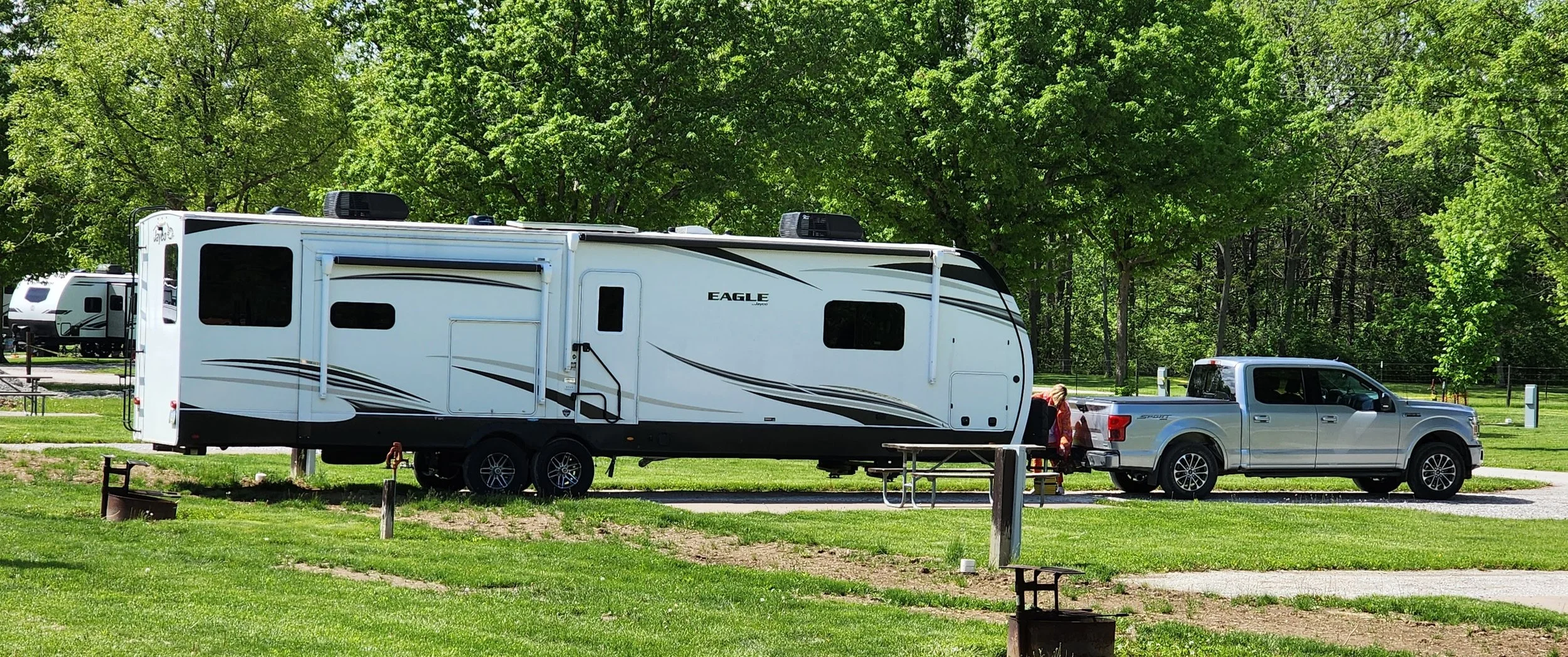
ABOVE: Someone along the way most likely said “It’ll be fine” or “Send it!”. At a whoppin 12,500 lbs GVWR, this travel trailer is being towed by a 1/2-ton pickup - the exact recipe for bad advice at the wrong time. Spotted in a campground in the mid-west on our cross-country journeys. Yes, I know - we posted this on a previous blog post too, but this was just too unbelievable to only post once.
At RV Tow Lantern, we specialize in looking at your situation in a holistic method that is backed up by solid math and personal, long-term experience. We don't just frivolously throw out information and say "Yup, send it!".
When you think about the sheer amount of bad advice out there (or when you start to realize this as a newcomer to the RV Lifestyle), it can be disheartening. So why not turn to A.I. (like ChatGPT or Gemini)?
AI tools can sometimes point you in the right direction — but they also pull from a mix of good information, bad information, forum opinions, and incomplete assumptions.
That’s why context and real-world experience still matter.
A Recent Example of Bad Advice
The other day, a popular RV YouTube channel released a video explaining truck maintenance mixed with towing setup concepts (no, I am not going to call the channel out by name). Unfortunately, much of the information being presented was factually incorrect. What made it even more concerning was scrolling through the comments afterward — because while some experienced mechanics and RVers were correctly pointing out the problems, other commenters were confidently repeating and celebrating the misinformation too!
That’s the difficult part for RV Lifestyle newcomers:
How do you know who’s actually right?
That confusion is exactly why RV Tow Lantern exists. We specifically built this and services to help combat all this misinformation and give you solid, actual numbers and clear guidance to the very questions of "Can I pull this RV?" or "Is this travel trailer and tow vehicle a safe combination?" We provide you with the whole picture, not just a "Send it!". And we also help with understanding the broader impact such as developing that all-important RV Lifestyle muscle so that you too can be well-informed.
Everything we do is carefully calculated and based on safety margins. We set expectations on what it'll feel like when towing your combination. And depending on your specific situation, we recommend tools and/or accessories that may change your towing experience entirely — not to mask any issues, but to enhance an already-safe recommendation.
The Point
Be extra vigilant where you get your RV advice. We talk about this in our RV Buyer Blueprint because, obviously, most people in forums or Facebook groups (RV Lifestyle Group, anyone?) are not experts. Nor are some of the RV YouTubers* giving safe, or even sane, recommendations. For a new RVer (or even some experienced RVers), it's hard to decipher who is right… and who is not.
If you're already starting the process of really narrowing down your RV and want some real answers quickly, we have our compatibility check service that will absolutely get that confidence quickly:
Want to research it more on your own and really dig in? Then the RV Buyer Blueprint is exactly what you need to run through weights, calculations, as well as information on what essential accessories you need to start the RV Lifestyle — without breaking the bank on useless products that many of these RV videos promote:
And if you haven’t already, be sure to download our RV Lifestyle Roadmap here:
It doesn't have to be super expensive to start out. Let's filter out the noise and get you on the right track, now!
* There are indeed some absolutely great and trustworthy RV YouTubers. We cover some of these channels and resources in the RV Buyer Blueprint.