Can a ¾-ton Tow a 15K 5th Wheel?
Why the answer depends on payload, pin weight, and remaining margin — not just the badge on the truck.
I recently saw a detailed discussion around a newer gas ¾-ton truck towing a 15,000 lb GVWR 5th wheel. And to be fair, the guy presenting it did a pretty good job showing his work. He had real scale numbers, a detailed spreadsheet, and he was clear that this was for his specific truck and his specific 5th wheel. This already puts him ahead of the usual internet advice of “Send it!” or “You’ll be fineeee!”.
However, when I see this, I start to get a little concerned.
The numbers may have technically worked in that very specific case, but the remaining payload margin was razor thin. And this is the part viewers or general consumers of the content really need to understand before applying the same idea to their own truck.
A lot of people are going to see something like that and walk away thinking:
“Well, he’s towing a 15K fifth wheel with a ¾-ton, so I should be fine too!”
And that’s it. Any second thought they might have had quickly dissipates because they may have just found what they needed to confirm that their current tow vehicle or the one they were interested in purchasing anyways was enough.
They’ve seen it done. This guy is doing it. We’re good. Send it!
And this is where things can go sideways very quickly.
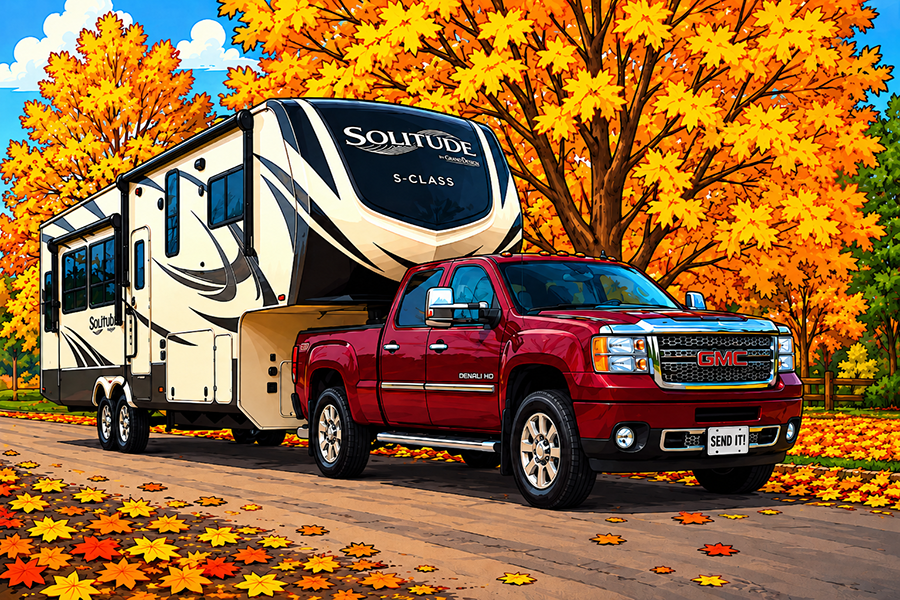
ABOVE: Sometimes there’s no badging on the truck that gives away whether it’s a 3/4-ton or a 1-ton truck. Nonetheless, the truth is a little deeper on the payload tag of the RV and the weight of the 5th wheel —all of which ultimately need to be verified.
Interestingly enough, just this morning I saw yet another post in an RV Facebook group where someone had bought a ¾-ton truck and a large 5th wheel, and then started asking the public if the combination was actually ok. Something in their mind wasn’t sitting right, as it should. And, as expected, plenty of people jumped in with the usual responses:
“It’ll be fine.”
“You have enough truck.”
“I tow more than that with mine.”
(This is exactly why I wrote about the danger of trusting random towing advice in the first place).
But very few were asking the questions that actually matter in this case:
What is the truck’s actual payload sticker?
What is the loaded pin weight?
How much does the fifth wheel hitch weigh?
How many people are riding in the truck?
What is going in the bed?
Is there water onboard?
What does the truck have left after all of that?
In the forums and groups I follow, that’s the part that people skip way, way too often.
This is one of the things I’m trying to bring attention to with RV Tow Lantern. People tend to copy what they see. They see a truck and RV combination online, at a campground, or in a video and think, “Well, they’re doing it, so it must be okay.”
Then someone else copies it.
Then someone else copies it again.
You ever see a copy of a copy of a copy? Things start to get pretty fuzzy.
And before long, we have a whole chain of copy-and-paste RV setups going down the road that may never have had much safety margin built into them in the first place. I see this often with large bunkhouse travel trailers being pulled by small ½-ton Tahoe’s, Suburban’s, Expedition’s, and Sequoia’s.
That matters even more when the setup is being shown by someone with a YouTube channel, Facebook following, Instagram account, or any kind of social media audience. People naturally assume that if someone has a platform, they have authority, so they must have everything figured out.
And, sure, maybe they do.
But maybe they also have a very specific truck, a very specific trailer, a very specific way of loading, and a personal comfort level that may not apply to you at all – especially if you’re a newer RVer.
In the example I watched, I went ahead and ran the basic numbers because most of the needed information was available. At the end of it, the remaining payload safety margin came out to roughly 7%.
That’s only a little over a couple hundred pounds of payload left before hitting the truck’s limit. Again, the presenter did admit to the exact payload in pounds that was left over, and full credit he did that, so it was easy for me to validate my calculations as well.
Now, yes, technically that may still be under the number. But that is not much breathing room (and the pun here is fully intended).
A couple extra items in the bed, a slightly heavier 5th wheel hitch (or weight distribution hitch if we’re looking at a travel trailer), a few more tools, a generator, some extra water for a boondocking trip, a change in how the fifth wheel is packed, a few upgrades on either the truck or the 5th wheel or travel trailer, or a higher-than-expected loaded pin/hitch weight can eat that razor thin remaining payload up so very quickly without you even realizing it.
And that’s where I feel people need to be so extra careful — there’s a difference between “the math technically works” and “this setup has enough margin to feel good long term.”
As most of my followers probably know by now, I like to see at least a 10% safety margin as a minimum — and this is usually at the vehicle’s GVWR, not a lower “hey, I’ll just load it up to this lower number so I can make it”. Personally, I’m much happier when a setup has closer to 20% or more (again, using the RV’s GVWR). And this is not because I enjoy telling people to buy bigger trucks (trust me, I know they’re expensive and that can be a hard pill to swallow if you’re already invested in or own a smaller tow vehicle), but margin gives you room for real life.
Bad weather.
Crosswinds.
Long grades.
Emergency maneuvers.
Extra gear.
Boondocking water.
A generator.
A few unexpended extra souvenirs (trust me on this one!).
A dog… or three 😅.
Kids getting bigger (and requiring more personal items in the RV).
Camping habits changing over time.
These things absolutely happen. And if you’re already balancing every pound just to make the setup work, RV travel can start feeling like a management exercise instead of something you’re supposed to enjoy.
That’s why I don’t love the broad question of “Can a ¾-ton tow a 15K fifth wheel?”
The better question is:
Can this specific truck, with this specific payload sticker, this specific hitch, this specific cargo/passenger load, and this specific loaded pin weight tow this fifth wheel with enough margin to make sense?
That’s a totally different question.
Two trucks can both say 2500, F-250, or 2500HD on the side and still have very different payload ratings. Gas versus diesel matters. Trim level matters. Cab configuration matters. Bed length matters. Options matter. Aftermarket accessories matter. Vehicle frames/chassis matter. And the payload sticker on the door matters more than the badge on the fender.
So, can a ¾-ton tow a 15K fifth wheel?
Maybe.
In a very specific case, with the right truck, the right fifth wheel, careful loading, and a very clear understanding of the remaining margin, it might technically work.
But that is not the same thing as saying:
“A ¾-ton can tow a 15K fifth wheel.”
That’s too broad.
In the example I reviewed, a 1-ton SRW gas truck would have been the cleaner choice from a margin standpoint. Not because the ¾-ton was automatically incapable, but because the 1-ton would give more room, more flexibility, and less need to manage everything so tightly.
And that’s really the point:
Sometimes the better setup is not the one that barely works — it’s the one that lets you actually enjoy the trip and future, planned or unplanned possibilities.
I’m not saying this to be the Tow Police (hey, I’m used to that label by now!). I’m saying it because I keep seeing people get into RV setups where everything looked fine at first, but later they realize they had very little room left for how they actually travel.
If you see someone online towing a large 5th wheel with a ¾-ton truck, don’t automatically assume your setup will work the same way.
Check your own door sticker.
Estimate real loaded pin weight.
Account for the hitch, passengers, cargo, water, tools, and accessories.
And leave yourself some breathing room.
Because the goal isn’t just to be technically under a number. The goal is to have a setup that feels stable, predictable, and comfortable enough that you can actually enjoy the RV lifestyle you were trying to build in the first place.
If you’re looking at a specific truck and RV combination and want a clear answer before committing, that’s exactly what the Tow Vehicle & RV Compatibility Check is for.
If you’re still earlier in the buying process and want to understand how to evaluate these decisions yourself, the RV Buyer Blueprint walks through the process step-by-step.
Either way, take information in, but always educate yourself before you make the commitment or continue with an unsafe setup.