Are ¾-Ton Trucks Really the Same as 1-Ton Trucks?
Same engine, same frame, same truck? Not always.
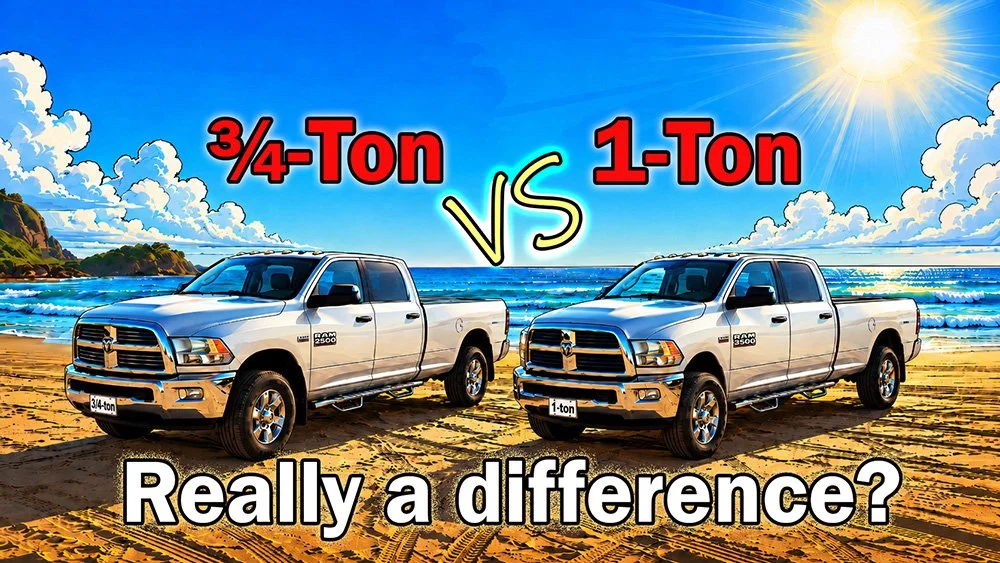
As with most of my articles, this one was inspired from a comment I have run into more than once:
“¾-ton trucks and 1-ton trucks are basically the same.”
Well… yes.
Sometimes.
But also… no.
Not in the way that matters when you are trying to safely tow a 5th wheel.
I saw this come up again when someone asked why a guy with a borderline 5th wheel setup didn’t just move up to a 1-ton truck. It was a totally reasonable question! If you are already flirting with your payload or rear axle rating, moving up a class gives you breathing room. It gives you margin. It gives you room for passengers, cargo, hitch weight, future upgrades (on both the RV and truck), and the inevitable “we packed more than we thought” situation (boondocking, anyone?).
The response came back quickly:
“My ¾-ton is the same as a 1-ton. Same engine. Same transmission. Same rear end. Same leaf springs. Same frame. The only difference is the sticker on the door.”
Boom. Mic drop.
Except… not quite.
This is where the conversation gets sticky, because there is some truth buried in that argument. Depending on the year, brand, trim, cab, axle ratio, suspension package, and GVWR package, some ¾-ton and 1-ton trucks really do share a surprising amount of hardware.
In certain cases, a ¾-ton may be close enough to its 1-ton counterpart that it feels like a “1-ton in disguise.” The lower rating may not come down to one obvious part you can point to in the driveway. It may have more to do with how that specific truck was certified, packaged, marketed, registered, insured, or classified.
But here is the catch: “shares parts with” is not the same thing as “is rated the same as.”
Unless that specific truck was certified by the manufacturer with the higher GVWR, GAWR, and payload rating, it is still limited by the numbers printed on that truck. And when you are towing a 5th wheel, those numbers matter.
A ¾-ton truck may share an engine and transmission with its 1-ton brother. It may even share the same axle in some configurations.
But the 1-ton may still have different rear springs, overload springs, axle ratings, shock package, tire/wheel ratings, hitch provisions, GVWR package, or certified payload rating. In some cases, the frame or frame/chassis package may be different too — and this is not always obvious from a visual driveway inspection.
GM is a good example of why this gets confusing. On some Sierra 2500HD configurations, the available Max Trailering Package specifically lists a 3500 HD Frame, 3500 HD Leaf Springs, 12-inch rear axle, 3500 HD Shock Package, and 5th/gooseneck provisions.
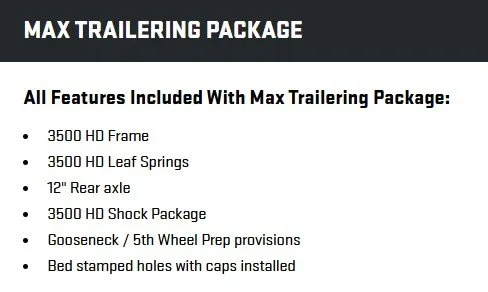
ABOVE: GMC’s own build 2026 configurator for certain Sierra 3/4-ton 2500HD Max Trailering Package configurations lists a “3500 HD Frame”, “3500 HD Leaf Springs”, “12-inch rear axle”, AND a “3500 HD Shock Package.” This is exactly why blanket statements like “2500s and 3500s are always the same truck except for the sticker” is misleading. Sometimes the hardware and package details matter.
So no, it is not always safe to say, “It’s the exact same truck except for the sticker.”
But the opposite blanket statement is risky too. Sometimes these trucks do share major hardware. That is why the real answer is not found in the badge, a forum comment, or someone’s “driveway inspection”. Instead, it is found in the actual door labels, manufacturer towing charts, and exact configuration of that specific truck. This is why we always recommend “sticking with the sticker” (the actual sticker and manufacturer ratings when working with clients on their ¾-ton truck setups) for GVWR when working with our clients on their 3/4-ton trucks and our Tow Vehicle & RV Compatibility Analysis.
Ram is a good example of why blanket statements like this tend to get people in trouble. On modern Ram HD pickups, the 2500 and 3500 are not simply “the same truck with a different badge.” The 2500 is known for its rear five-link coil suspension, while the 3500 uses a traditional rear leaf-spring setup. That alone is a major difference in how the trucks are configured and rated.
Ford and GM have their own package-specific differences too. Sometimes the trucks share a surprising amount of hardware. Other times, a specific tow package, axle, spring pack, GVWR package, or frame/chassis configuration changes the picture. That is why two trucks that look nearly identical on a dealer lot can still have very different payload stickers.
So how do you know what you actually have?
Do not rely on internet comments or YouTube videos. Do not rely on the badge. And definitely do not rely on “my buddy said it’s the same truck!”
Check these items on your specific truck:
GVWR
Front and rear GAWR
Payload sticker
Tire load rating
Wheel rating
Axle ratio
Rear suspension package
Hitch rating
5th wheel/gooseneck prep rating
Manufacturer towing guide or VIN-specific lookup for your exact configuration (something we look up for our clients in our Compatibility Analysis).
This last part matters - not just “a 2022 F-250” or “a Ram 2500 diesel.” You need the right cab, bed length, engine, drivetrain, axle ratio, GVWR package, and wheel configuration. All of these factors work together to affect the final ratings
Now, let’s talk about upgrades.
Can airbags, helper springs (such as Timbrens), higher-load-rated tires, or upgraded suspension parts make a truck sit better and feel more stable? Yes, totally. In some cases, they really can improve the towing experience!
But do they magically change the manufacturer-certified payload rating on the door sticker? That’s a negative, Ghost Rider. They do not turn a ¾-ton into a 1-ton on paper. They do not change the GVWR or GAWR that the truck was certified with from the factory.
And if something goes wrong, that paper trail may matter.
This is the part nobody likes to talk about, but it’s real. I am not saying insurance automatically disappears because someone is over a rating. That gets repeated online a lot, and the real world is usually more complicated than that.
What I am saying is this: if something serious happens, the paper trail may matter. An adjuster, investigator, attorney, or accident reconstruction expert may look at the door jamb payload sticker, GVWR, GAWR, trailer weight, pin weight, tire ratings, hitch ratings, and whether the combination was being operated within the manufacturer’s limits.
Airbags or upgraded suspension may help the truck sit better or feel more stable, but they do not erase the original ratings printed on the truck.
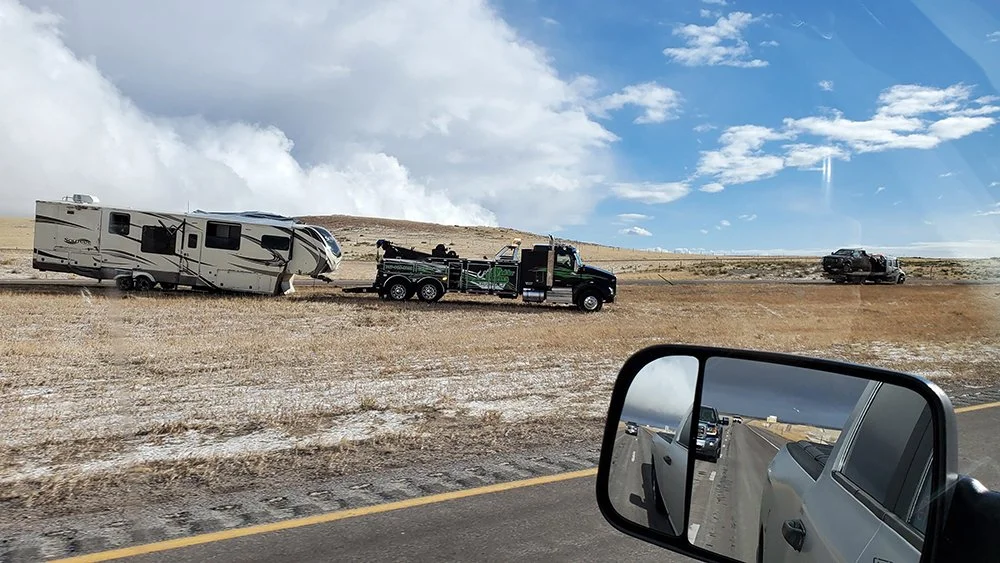
ABOVE: A windy day caused a rollover with this truck and fifth wheel on I-25. We cannot tell from the photo what the exact weight situation was, so I am not using this as proof of an overloaded setup. But it is a good reminder that wind, speed, stability, driver reaction, and margin all become very real once something starts going wrong. Are you confident in your setup?
That does not mean every ¾-ton truck is unsafe with a 5th wheel. Far from it! There are plenty of ¾-ton trucks towing within their ratings every day.
But if your whole argument depends on saying, “It’s basically a 1-ton!” that is usually a sign you’re already too close to the line.
And that brings us back to the real question:
If you are already at your limit — or over it — is it really worth the risk?
For some RV owners, the right answer is to pack lighter, choose a smaller trailer, or move to a truck with more payload. I know, I know… That is not always the fun answer. Nobody wants to hear “trade up” after they already bought the truck or the RV.
But 5th wheels are extremely payload-hungry. Pin weight adds up much faster than you may anticipate. Passengers, tools, firewood, coolers, generators, bed covers, hitches, upgraded cattle bumpers, and “just a few things in the truck” all count to your final payload.
After all, at the end of the day, these are recreation vehicles. The whole point is to enjoy the trip, not spend every mile wondering if you are overloaded, under-trucked, or one emergency maneuver away from a very bad day.
If you want a clear read on your specific truck and RV combination before you commit — or before you keep towing a setup you’re unsure about — that’s exactly what the Tow Vehicle & RV Compatibility Check is for:
Regain your payload margin. Regain your confidence. And stay safe out there!