Travel Trailer Tongue Weight - A Delicate Dance of Weight Distribution for Stability
Here’s something we don’t think of very often as RV owners: what if we purposefully shifted some of our tongue weight back for more stability? Of course, we’re going to give a very strong warning here:
Having less than 10 or 11% tongue weight on a travel trailer is a recipe for disaster. Always ensure you have at least that amount before ever towing.
We’ll start with a personal example where this turned out to be helpful. When we owned our Tahoe and Keystone Bullet, we used to do a fair amount of dry camping out in the woods. Since we were gone for multiple days (and back then solar and battery bank power solutions weren’t as prevalent and affordable as they are today), we would take our 100 lb Champion inverter generator with us. By default, I would always plunk it in the back of our Tahoe.
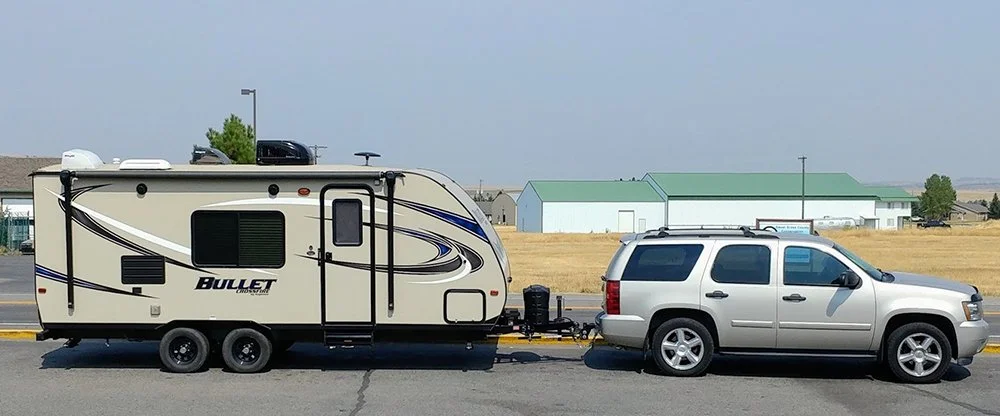
This was our exact setup we used to take to the woods whenever we could escape!
On this particular day as we headed to our spot in the forest, I noticed that the handling was a bit more poor than usual. Or perhaps I just happened to notice that it was poor in general – something I just hadn’t specifically paid attention to while on a certain wavy stretch of backroads. For all intents and purposes, it felt as though we were backheavy as the steering just didn’t feel as planted as I like it to be.
To set this up properly, we had our 4-point weight distribution hitch installed at the time and we also were running with a full tank of fresh water. As mentioned above, our 100 lb generator was sitting in the rear cargo area of our Tahoe.
At some point we ended up stopping and I was checking the suspension components of the Tahoe as well as the integrity of the trailer to see if I could determine why it felt so funky. I didn’t notice anything, but the feeling that we were still backheavy on the Tahoe (or perhaps tongue heavy on the travel trailer) kept gnawing at me. So, for kicks, we relieved some of the pressure by taking out the generator from the Tahoe and putting it into the travel trailer. Since there really wasn’t a good place to secure it, we moved it towards the rear of the travel trailer, closed the door, then took off back down the road.
What happened next absolutely astounded us. The entire handling characteristics had dramatically changed. No longer were we bobbing around as much in the tow vehicle as we traversed some of that uneven road. Somehow everything just felt more… balanced.
With forums and even RV model design cues, we’re inundated with so much information to pack as much as we can into the front of our trailers – from cargo trailers (loading heavy items like washers and dryers into the front), car haulers (always pulling the engine of the vehicle to the front of the trailer), and RVs (that’s why there’s large compartments there, right?) storing our heavy items up front. And this is actually the safest recommendation to use… in general. However, there is a such thing as having too much weight on the tongue of the trailer or rear of the two vehicle that can make the front end of the tow vehicle feel floaty – especially in cases when no weight distribution hitch is used.
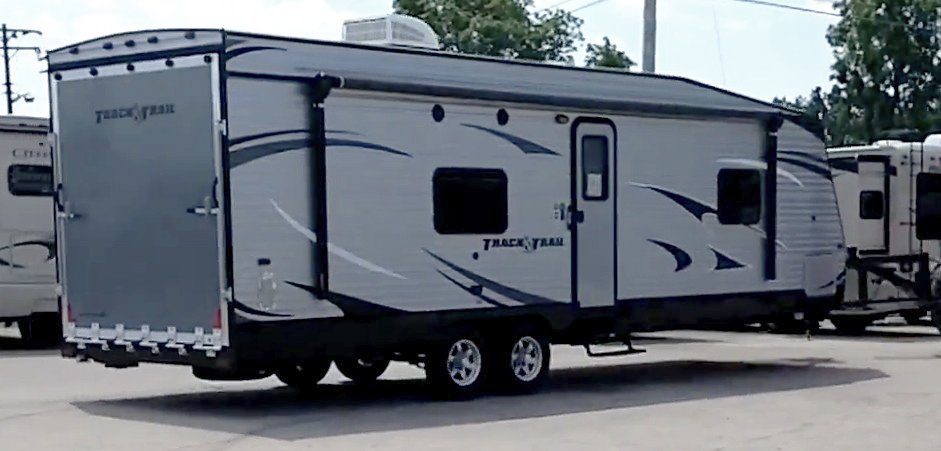
A still from a video of our first attempt at buying an RV - this is our Track and Trail Tow Hauler we bought 10 years ago but had to return it because of a water leak.
Let’s look at another extreme example: unloaded garages of toy haulers, but still fully loading the front living area. As the name implies, toy haulers in both the bumper pull and 5th wheel variety, will have most of the static weight shifted forward as the manufacturer expects you to be hauling a load in the rear garage area to help balance out the forward weight. To further help balance this load, the manufacturers will typically place the trailer axles more towards the rear than you typically see on a travel trailer. If you’re towing an empty toy hauler, your weight will be fairly unbalanced (especially if you load them up with your standard living gear like food and clothing) causing a much higher weight percentage to be on the tongue of your trailer or king pin – and thus transferring to the rear of the tow vehicle.
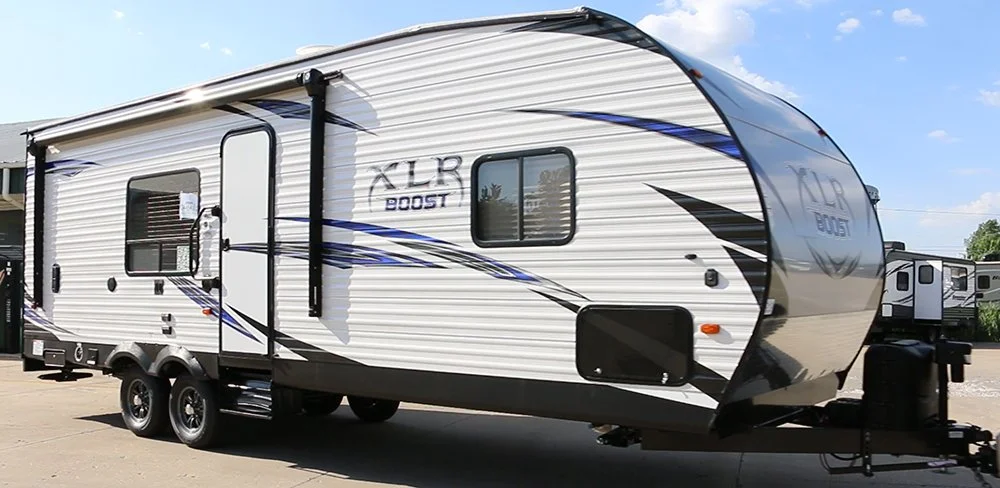
Our second attempt at buying an RV. This was an XLR Boost toy hauler. This is the moment we were towing it off the lot. Note the axle position because of balancing needed for the rear garage.
A few weeks ago, we were helping a neighbor move their toy hauler on their property so they could level it out better. The garage area was relatively empty, but the front half of the trailer was packed with normal items you would take with you on your RVing adventures. Additionally, there is a large on-board generator installed in front of the toy hauler along with the typical batteries and propane tanks. The amount of sag our Ram 2500 incurred was a bit concerning when we dropped the trailer tongue down onto the hitch ball. We still moved the trailer with ease as it was probably not more than 10,500 lbs, but that weight imbalance would be very concerning if we were to take it out on the road without some major balancing or a very aggressively set weight distribution hitch. In fact, with the current configuration that trailer was in, a 1-ton SRW or even a DRW would be preferable. As always, the only way to know what the real weights would be to take it to a scale, but this wasn’t our science experiment – we just needed to help move it around on their properly.
If you’re our neighbor reading this at a later date, there’s no worries here. We’ve hauled so many trailers that this is just yet another experience for us to understand more of the dynamics of weight distribution (and, of course, we wanted to help out!).
To continue the story with the weight distribution in our Tahoe and Keystone Bullet, when our fresh water tank was depleted when we left the campground, we did move the generator inside the travel trailer back to the front of the RV - that seemed to be the magic trick we needed to ensure everything still felt comfortable while cursing down the road.
So next time you feel a little backheavy, consider balancing your load, but pay extra careful attention to your tongue weight to ensure it’s dialed in to at least 10-12% of your trailer’s weight.
If you’re still unsure about weights and would like a granular step-by-step walkthough how to calclulate and how to ensure you’re ready for your RV journey, be sure to check out our RV Buyer Blueprint.