Fuel Stations — The Ultimate Road Challenge for Gasoline Tow Vehicles
The Half-Tank Warning
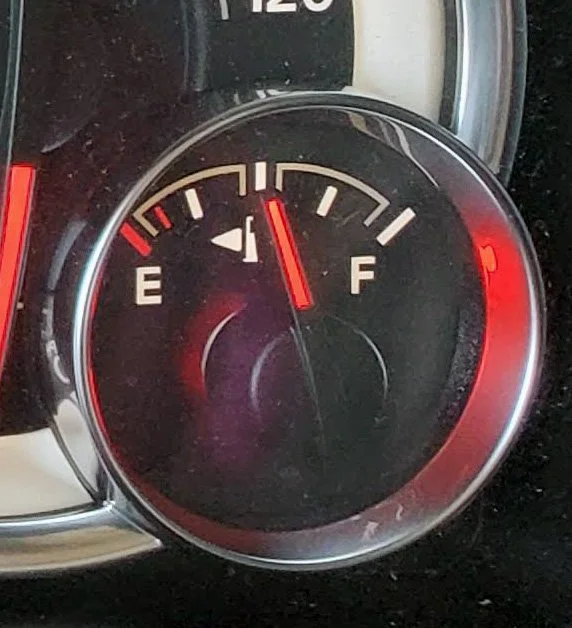
So there we are — cruising down the interstate. I look down at the fuel gauge. It just hit the ½ tank mark. Exchanging glances with my wife, we know it’s time. She pulls out here phone and immediately springs into action.
For most drivers, stopping for gas is simple: watch the passing road signs, find the next station, pull in, fill up, refill the 40 oz wild cherry slushy, perhaps empty the bladder, and get back on the road. But when you’re towing a trailer with a gasoline-powered truck or SUV, that simple fuel stop can quickly become the difference between an efficient 15-minute stop and a one-hour fiasco.
Longingly, I stare at the at pickups with RVs pulling into the truck lanes to fill up with diesel. Plenty of space and so little to worry about.
So, why is this so complicated?
Well, when you are towing a trailer, especially with a tow vehicle that takes regular ol’ unleaded gas, things can get hairy real quick without a little planning.
Who This Article Is For
Just to clarify, this article is for trucks, SUVs, and motorhomes that take regular gasoline.
If you have a diesel pickup or diesel motorhome, this may not be as big of an issue because you can generally use the semi-truck fuel lanes.
Just make sure you are practicing good fuel-stop etiquette so you don’t cause delays for the truckers.
But for the majority of us using the same stuff we put into our lawnmower, fuel stops can be surprisingly challenging.
Why Fuel Stops Are Harder When You’re Towing
Let’s first point out the obvious: the shorter your trailer or motorcoach is, the less of a problem filling your tank will be. But as soon as your trailer starts getting beyond the 15-foot mark, now we have to be a bit more careful about where we choose to stop.
The issue usually is not the pump itself — the issue is everything around the pump:
90° turns
Poor traffic flow
Cars strewn about in random places
Curbs at the wrong places and angles
Storefronts too close to the pump lanes
And other drivers who do not realize how much room a trailer needs
Let’s take a look at our RV, for example. Bumper-to-bumper, it’s only 10 to 12 feet shorter than an average semi-truck! Now try to squeeze this into most typical passenger car fueling lanes and you potentially have a mess on your hands.
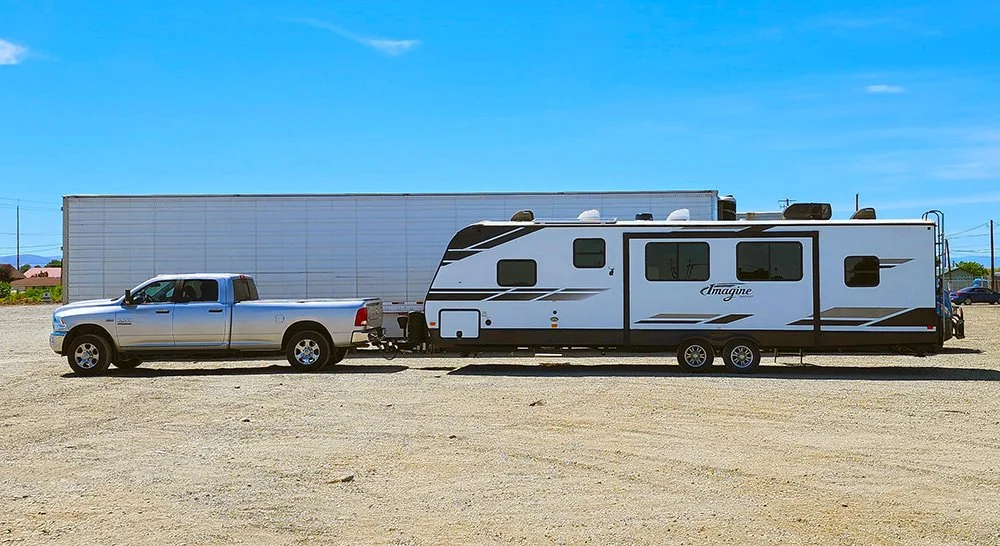
ABOVE: Look carefully at the background - we are parked next to a semi Yes, although perspective of the photo puts us closer to the camera, thus slightly skewing the result, we are indeed parked fairly close together to make this a fair comparison.
The Dream Scenario: A Real RV-Friendly Gasoline Lane
If you’re very lucky, your fuel station will have a dedicated RV lane that actually serves gasoline.
This is rare.
I can only recall a handful of stations, out of hundreds of stops, that had a truly useful gasoline RV lane. When they do exist, they are absolutely wonderful. You can pull in, fuel up, and pull straight out without doing automobile yoga in the parking lot.
But most of the time, that is not what we get.
Note: Don’t be deceived by the signs that say RV pumps and point to the back of the fuel stations where the truckers are. Most of these lanes, although having a dedicated RV lane, actually only serve diesel — not regular gas. Ask us how we know…
So now what?
Step One: Scout the Station BEFORE You Commit
When we hit half a tank, my wife usually pulls up Google Maps and starts looking for fuel stations ahead.
We are not just looking for the closest station — we are actually looking for the station that gives us the best chance of getting in and out without creating a scene.
Some things we look for (in this order):
Pumps that are parallel to the road or parking lot flow
Wide lanes between pump islands
A clear exit path after fueling
Room to turn around by looping back behind the building if needed
Multiple entrances and exits
Light traffic in and around the station
A station that also has a place where we can pull into and access the trailer for a bathroom break
Here is an example of a fuel station that is optimal. We almost never pass these up if we’re below a ¾ of a tank.
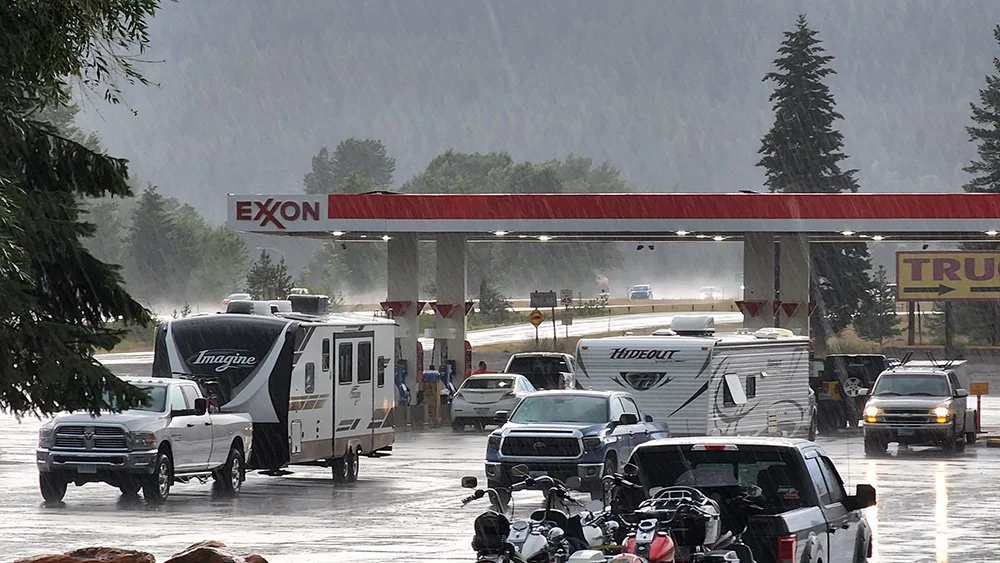
ABOVE: The fuel pumps right outside of Lincoln's 50,000 Silver Dollar Bar located in western Montana. These are our absolutely favorite pump orientation as they are parallel to the road and there is no storefront located on either side of the pumps — we can just drive straight through when we’re done and even park up ahead for a bathroom break… even if it’s raining really hard!
If we can find a fuel station with pumps positioned in a way that lets us pull through cleanly, that is usually our best bet, like in the above example.
Providing there is ample space between each row of pumps, and it’s not jammed with traffic when we approach, then we’re golden.
Sometimes it in this arrangement it takes a little longer because we can’t just “go around” the vehicles in front of us. If we need fuel and have stopped at a rear pump due to the front ones being occupied, we may have to wait in line until everyone clears before we can exit.
But waiting a few extra minutes is still better than getting trapped!
Perpendicular Fuel Pumps: The Norm
The vast majority of gasoline pumps are situated perpendicular to the storefront.
This is where things get tricky.
Now we have to contend with several factors, including:
The storefront being right smack up against the pumps
A tight curb at the far end of the pump lanes
No clear path to make a wide right or left turn because of cars parked up at the storefront
Traffic entering from both directions
Pump islands that force you to exit at a bad angle
The worst-case scenario is when the pumps are too close to the storefront on one side and too close to a curb on the other side.
Yes, we have had to deal with this before. And no, it was not pleasant getting in or out of there.
The below image of Common Sense near Sheridan, Wyoming is quite possibly one of the worst places to get unleaded gas in an RV. This is an absolute shame because this particular travel store has really nice and clean facilities, plus some most excellent food. We made this mistake once and, as you can see from the map below, there is no clean way out.
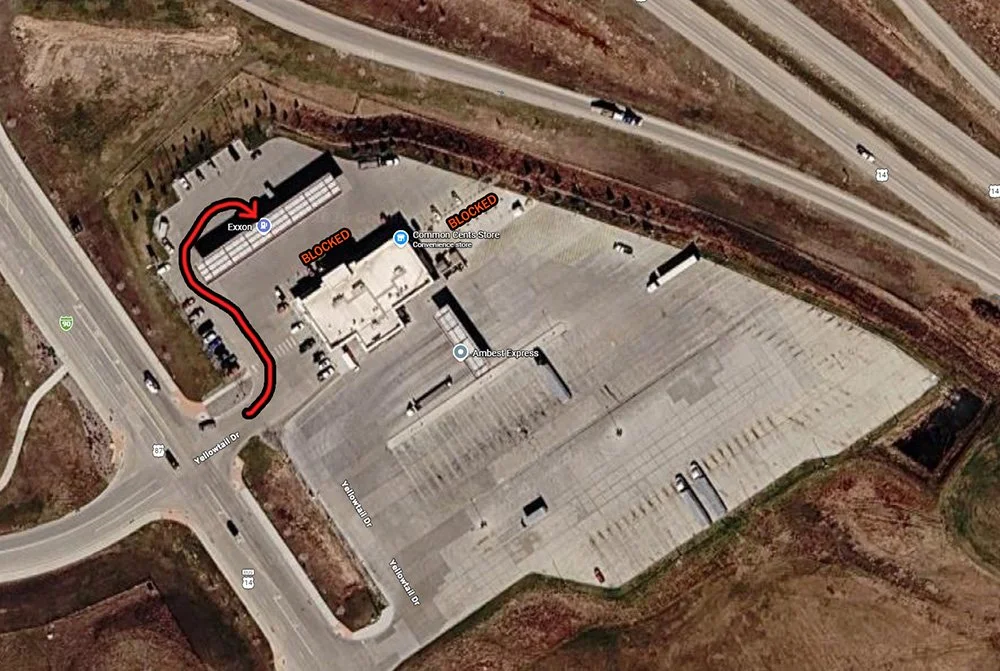
ABOVE: After fueling, we had to back completely out backwards and into the trucking lot because there was not enough room to turn around at the pumps due to all the cars blocking the front of the building. Strangely, they also have the northeast lot blocked so you can’t drive out around the building either (probably to block semitrucks from entering in this way by accident).
This was the last time we visited this gas station while towing. To get out, my wife had to direct traffic and be my “eyes” as we backed clean out to trucking area where we could then turn around. Two-way radios sure come in handy for situations like this.
Trick #1: The End Cap Maneuver
When faced with perpendicular pumps, our first choice is usually the outside pump. I call this the End Cap Maneuver, or ECM for short.
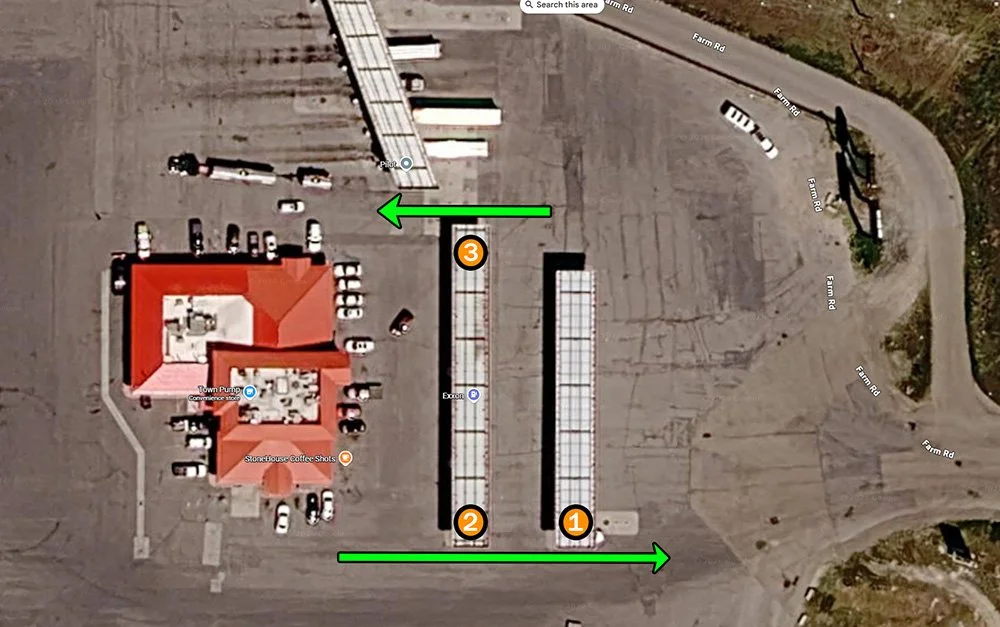
ABOVE: The gas station in central Montana near Three Forks is our best bet on getting refueled and then having a great place to park way out back for a bathroom break and rest. Occasionally we’ll run into the store and get some good’ol gas station food.
The outside pump gives you the best possible angle for entry and exit. It also reduces the chance of being boxed in by cars on both sides.
This works best when you can drive around the building either before fueling or after fueling. That gives you a chance to position yourself on the correct side of the pump and then exit without making an impossible turn. Note in the above photo, you can fuel at locations 1,2, and 3 with relative ease — just by looping around the building.
The End Cap Maneuver is not always available, but when it is, it’s usually the safest and least stressful option. The only disadvantage is when small cars use the end pumps, look at you waiting behind them to pull in, then casually turning around, clicking their lock button, then lazily stroll into the store for a bathroom evacuation and snack food and soda binge. Can you sense this has happened a few times? 😉
Trick #2: The Backout Method
Sometimes there is no getting around it. You pull into the pump, get your fuel, and then realize the only realistic way out is to back up.
This is not ideal, but sometimes it is necessary.
The Backout Method requires special attention to:
Your rear camera
Your mirrors
Your trailer swing
Cross traffic
Pedestrians
Vehicles trying to sneak around you
Your spotter, if you have one
My wife will typically grab one of our two-way radios, head to the back of the trailer, and act as both lookout and traffic director.
Is it optimal?
Nope.
Does it get the job done?
Yup.
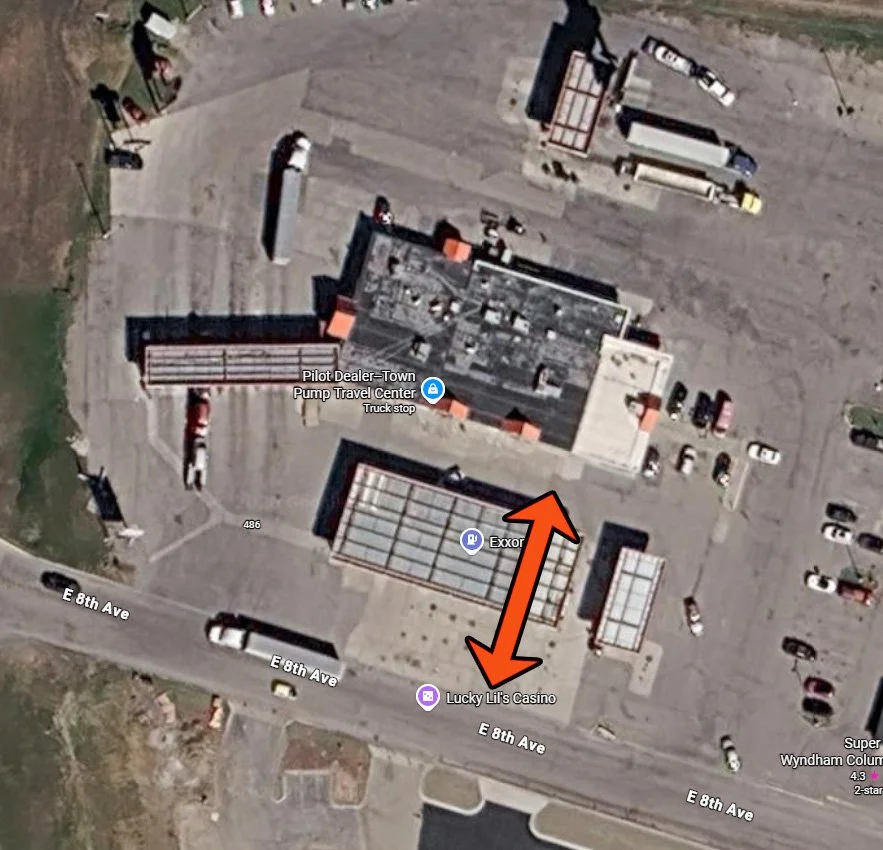
ABOVE: Here’s an example of a station that we often fuel at. We have to pull in forward, fuel, then back out onto the roadway. Again, my wife combined with the the two-way radios is absolutely necessary here.
Travel Centers Are Not Always RV-Friendly for Gasoline Tow Vehicles
This is where things get frustrating.
Some travel centers heavily promote their RV-friendly ecosystem. They may offer overnight RV spots, hookups, RV parking, and plenty of amenities.
But that does not always mean their gasoline pump layout is friendly for people towing with gas trucks and SUVs.
For example, we have had enough awkward fuel-and-backout situations at Love’s stations. And from this Groundhog’s Day experience, we now generally avoid them whenever we can. Their layouts are often too predictable in the wrong way: convenient for cars, workable for diesel trucks out back, but not always great for gasoline tow vehicles.
I find the Love’s situation particularly bizarre, because with how much they advocate RV life (such as their new Love’s RV Stops), they sure don’t follow through with their fuel planning. In these cases, if you’re using their RV spots for camping, do just that. Then find another place to refuel in the morning.
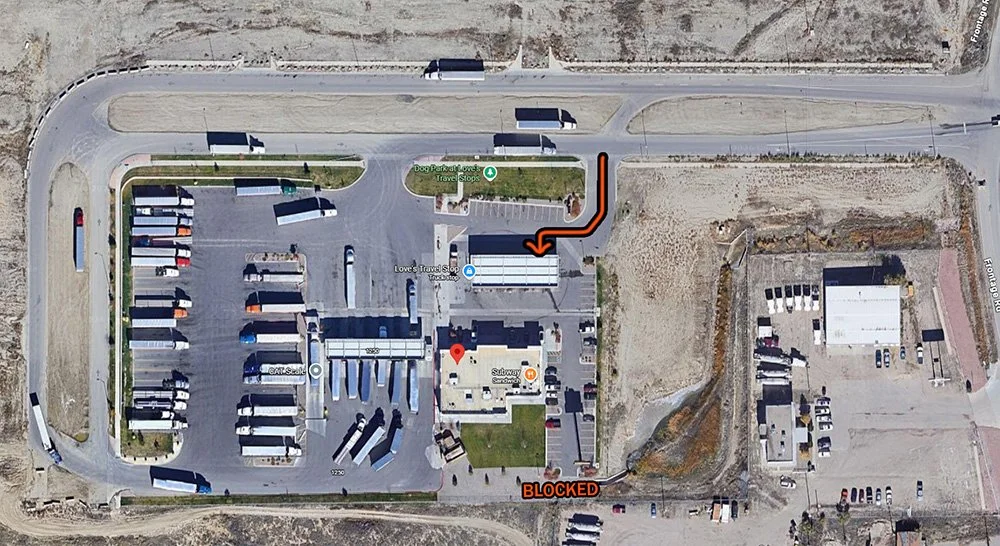
ABOVE: Another Love’s Travel Stop, this time at Pueblo, Colorado, left us in a pickle as we had to back out into some of the empty parking spots (which thankfully had a small gap big enough for us to fit into), then pull forward and the left again to get out of the service station. There was absolutely no place for us park so we had to pull around to the trucker’s lot and, feeling rather guilty, park in one of their spots and take our break very quickly.
Oh, But What About Buc-ee’s?
Buc-ee’s actually can be better.
Sometimes.
There is usually more room to navigate around their pumps, which helps. But the traffic can be quite intense, and there are often so many cars moving in every direction that the extra space does not always solve the problem.
But the biggest issue for RVers is that there is not always a suitable place to park an RV after fueling.
So while Buc-ee’s may look like the perfect stop on paper, we often skip it and choose a less busy fuel station instead. And this is especially valid when we see cars lined up to get into Buc-ee’s — just keep on driving and you’ll most likely find a great fueling stop just a couple miles down the road that’s relatively quiet and relaxing.
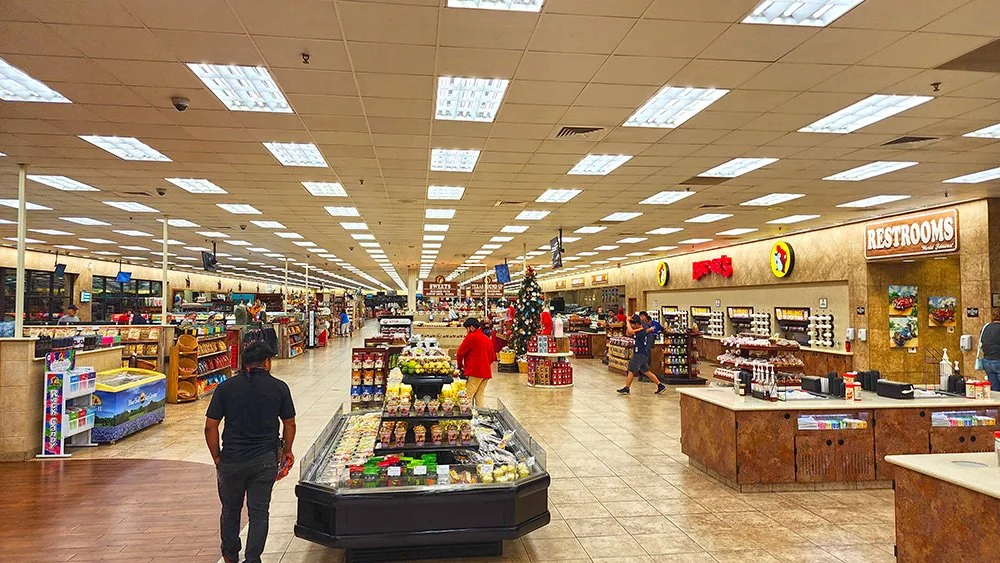
ABOVE: My first Buc-ee’s experience back in 2022 in Texas. Surprisingly, I don’t have many pictures of Buc-ee’s even though we’ve been to them quite frequently since then!
Our Basic Fuel Stop Strategy
So let’s firm up our fuel stop strategy we use when towing with a gasoline vehicle:
Start looking early, usually around half a tank.
Use satellite view on Google Maps to inspect the station layout.
Look for pull-through-friendly pump arrangements.
Favor outside pumps whenever possible for the End Cap Maneuver.
Avoid stations where the storefront is too close to the pump lanes.
Avoid stations with heavy local traffic if there is another option.
Never be afraid to skip a bad station and keep going. Afterall, you still have about a ½ tank of fuel left, right?
Use a spotter when backing up ALWAYS.
What Fuel Stations Could Do Better
So what is the solution?
For one, fuel stations could start adding a gasoline lane on the truck/RV side of the property. Afterall, many people choose gas over diesel to avoid the rising cost of fuel and maintenance that a diesel vehicle incurs.
This does not have to be complicated. A single pull-through gasoline lane with enough clearance for trailers would solve a major problem for a lot of travelers. And for a large operation like Love’s, whom seem to promote RV travel, this would be an absolute key to RVer loyality.
And this would not only help RVers.
There are masses of people towing with gasoline vehicles:
Horse trailers
U-Hauls
Car trailers
Cargo trailers
Boat trailers
Small travel trailers
Utility trailers
Toy haulers
All of these drivers would benefit from a better pump arrangement and a little assurance from the people on the road that you have their back. We need dependability on these already-stressful travel days — and this is a much-needed relief.
Final Thoughts
Fuel stops should not be one of the most stressful parts of towing, but for gasoline tow vehicles, they often are.
Until more fuel stations start designing pump layouts with trailers in mind, we have to do our own planning.
Start looking early. Study the layout. Favor wide exits. Use the outside pump when possible. And when a station looks questionable, trust your gut and move on.
A bad fuel stop can burn an hour, raise your blood pressure, and create an unnecessary safety issue.
A good fuel stop gets you back on the road in 15 minutes.
And when you’re towing, that difference matters.
If all else fails, don’t be afraid to drive down the street to a simple gas station. They may have a better arrangement and, after all, it’s a great way to support small business owners.
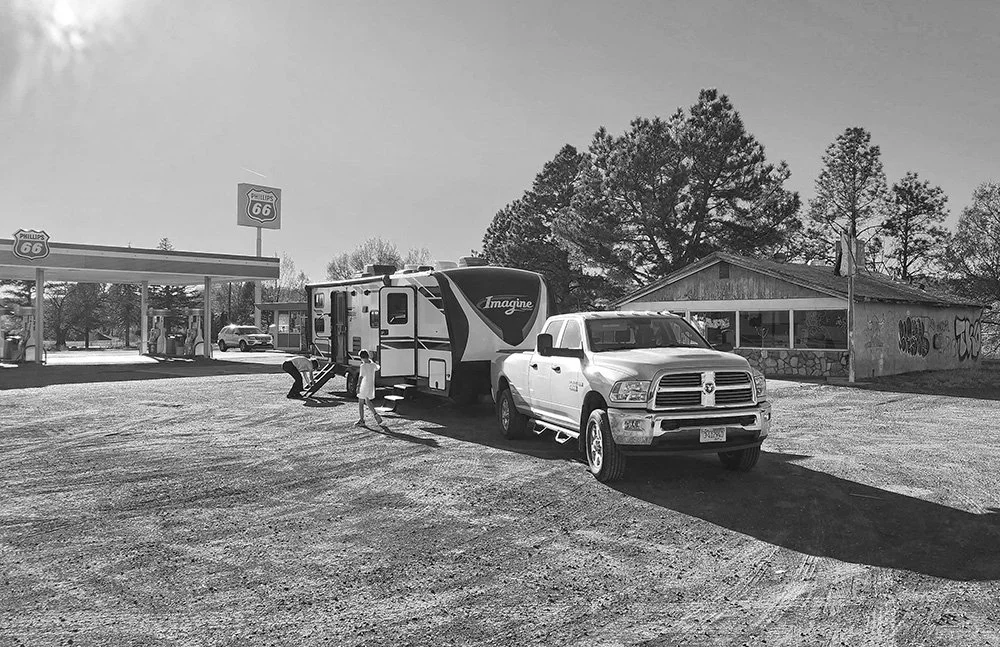
ABOVE: A perfect quick fuel stop somewhere in the middle of New Mexico. Pumps are parallel to the store, and there is a great place to park just ahead.
And this is also why choosing the right RV and tow vehicle combination matters so much.
That’s why I always encourage RV shoppers to look beyond floorplans and brochure weights. The right RV setup should work not just at the campsite, but also at the fuel station, the grocery store, the campground entrance, and everywhere in between.
If you’re in the buying stage, my RV Buyer Blueprint can help you think through those details before you commit. And if you’re unsure whether a specific truck and trailer combination is a good match, our Tow Vehicle Compatibility Service can help you sort through the numbers and the real-world considerations.
As always, stay safe, keep your tanks full, and have fun out there on your RV journey!